Showing posts with label Planning. Show all posts

Tuesday, May 22, 2007

Consensus Buildings vs. Robert Moses-style planning in Curitiba

From Richard Layman's blog, I saw this story about Curitiba, Brazil in the NYT Magazine. The parts about Bus Rapid Transit were why I clicked the link, but what I really noticed was the reasoning they gave for why transit ridership, recycling, and eco-mindedness all seem to be trending downwards in the city.

It made me think of the current re-examinations that have been going on in regards to Jane Jacobs and Robert Moses. When Jane Jacobs died last year, it seemed no newspaper could write about her without mentioning Robert Moses. And they couldn't talk about "Death and Life" without talking about "The Power Broker". For better or worse, they're likely to be linked forever in history. (Which will only gain momentum in 2008 when Anthony Flint's new book comes out.)

It was a contrast in styles — Jacobs was the grassroots organizer and neighborhood activist. From the bottom-up, she was able to save the Village. Moses had more consolidated power and authority than any urban planner or mayor will ever have again. So it's often uttered that what we need is another Robert Moses, albeit one who shares a pro-city perspective that values Jacobs' urbanism and people-first planning. This thought used to sound appealing to me, but now it scares me.

Consider: In Curitiba, the plans and implementation in the 60's and 70's came from one man in who was in some ways a figurehead leader who had power because the military dictatorship handed it to him. Quite different from Moses, but maybe not all that different after all. Curitiba might be a good lesson as to what happens when there is no consensus-building, no ownership, no charettes, no visioning, and no citizen particpation in the process of figuring out what sort of city to become:

“Curitiba began early to look at recycling garbage — that is true, and it is good,” says Teresa Urban, a local journalist and environmental activist. “But the separation of recycled garbage is a little part of all the garbage we have here. There is no tradition of participation here. The mayor sold to the people the idea that this is a wonderful city. And the people think, This is wonderful, I don’t have to do anything.”

Like other left-wing critics, Urban traces the lack of participation to an original sin. The progressive urban planning of Curitiba was not initiated by a democratic process; it was set in motion by the military dictatorship that seized power in 1964 and ruled Brazil until the mid-’80s. Its environmentalism is rooted in authoritarianism. “They didn’t have to confront the public through public participation, and the decisions could be made by urban planners — architects acting as politicians,” says Clara Irazabal, who has written a book comparing the urban planning experiences of Curitiba and Portland, Ore. The city that has been called the most forward-looking in the Western Hemisphere is an outgrowth of an era that many Brazilians prefer not to look back on. Jaime Lerner, the archangel of the Curitiba green movement, was anointed by the dragons of war...

...“He never asked if something was good or not,” Rischbieter remarks. “He would say, ‘I’ll go do it.’ I would say, ‘You have to go ask people and get their opinions.’ He would say, ‘No, they won’t agree with me, and it has to be done.’ He is not a political animal, he is a dictator.”
The story closes with a graf that hammers home the need for planning at the regional and megaregional scale:
Nor is Curitiba a single town any longer. It’s a conurbation. Planning must be for the metropolitan region, not just for the municipality. Does it matter that Curitiba bans polluting industries if the neighboring town of Araucária has an oil refinery belching smoke on the city line? Similarly, if the new immigrants to the poor surrounding communities don’t recycle, then Curitiba’s landfill, the only such facility in the metropolitan region, will fill up even sooner. Like garbage, water does not respect city limits: Curitiba’s water supply depends on reservoirs controlled by municipalities outside its borders. What was never simple has become even more complex. For a long time, the citizens of Curitiba were so proud of the city’s reputation as an urban showplace that they kept re-electing urban planners — self-styled technical experts who seemed to be above politics and who vaunted their expertise in running the buses, building the parks and recycling the garbage. But a mayor today must be able to negotiate successfully with other mayors if reform is to work. Mayors need to be politicians, even in Curitiba.

Thursday, May 10, 2007

Ugh: Urban real estate marketing makes me sick

I'm doing a little research into the whole project, so I won't go into detail about it right now, but I just downloaded the National Gateway brochure from their website after reading this story in the Post over the weekend.

They certainly aren't the worst of the bunch, but half the time, whoever has to write the dreck that appears on the marketing materials of the developers of condos and massive projects in DC likely flunked out of greeting card-writing school. I mean, haven't we all seen some really awful ones out there?

Have you seen these:

• The "eat", "sleep", "play" designation on the floorplans for new condo buildings are beyond annoying. "Boy, I can't wait to have some people over once I buy that new condo," said the hip urban single male. "Hey everybody, let's head into 'play' now that we've had some good stuff from 'eat'. Later, maybe one of you ladies will be lucky enough to make it back to 'sleep'. I mean, provided you want to either read or sleep, though, because those are the only options."


• Words that make me want to egg your building: "Distinctive", "Upscale", "Sophisticated", "Breathtaking", "Up-tempo", "Spectacular", "Dramatic", "Stunning". And FYI, I'm pretty sure the Allegro uses half of these on a regular basis.

• Claiming to be "just minutes from" Adams Morgan, Dupont, Downtown, Georgetown, and Capitol Hill, all at once. If you haven't seen this one on Craigslist, then you haven't been looking for an apartment anytime in the last...well...forever. Why don't you just go ahead and say "convenient access to The Moon."

• Once in the city and not doing the park and ride thang from miles away, 2 miles away does not qualify as NEAR the Metro. Believe me, I know a thing or two about walking to Metro.

• Anything that claims to now be "the most desirable address in Washington DC" makes me want to vomit. Not that all of us want to be president or anything, but you're pretty much not going to top 1600 Pennsylvania.

• USING ALL CAPITAL LETTERS ON MAILINGS, CL ADS, OR REAL ESTATE DOCUMENTS. SERIOUSLY, PEOPLE, IS THIS THE FIRST TIME YOU'VE USED A COMPUTER?

Here are some direct quotes from condo websites I've seen lately:
• "With such an array of combinations, you can make the lifestyle you envision a reality." Provided you have an eternal supply of cash, of course.

• "Columbia Heights is turning into the golden child for DC developers." Uh...are you selling to people or developers?

• "A dynamic atmosphere with a unique personality, the neighborhood boasts a rare and unique blend of commercial, residential and cultural experiences for its residents." blah blah blah blah blah

• "The _____ appeals to those who seek balance — balance between modernity and warmth." ?????

• "Convenient NW location - easy access to the White House, Capitol, Central Business District, C&O Canal, Potomac River, & Reagan National & Dulles Airports." Dulles? Really?

Anyway, so what got me all started on this was some blurbs from the National Gateway brochure:
• "The project will integrate over 185,000 square feet of restaurants, services, and shops in an architecturally significant streetscape that will define a sense of place rarely found in an urban location."

• "At National Gateway we endeavor to create a unique business environment, one in which sweeping views of the Potomac River, Washington, D.C. and a lush Center Park become part of the everyday landscape. And one in which the alignment of location, environment, access and visibility combine to create a vibrant mixed-use community that is more than a work place.” – David Cheek, President, The Meridian Group

• And lastly, "Setting new standards in urban design, National Gateway at Potomac Yard, Arlington Offers tenants an innovative mixed-use experience."
Whoah, dude, I have TOTALLY been craving an "innovative mixed-use experience". I have SO been trying to put words to the feeling I've had ever since I fell in love with the city. Jane Jacobs could have saved herself so much work if she had just latched onto that compelling sentence to describe the Village in NYC. Take that Robert Moses! "Don't infringe on our innovative mixed-use experience!"

As far as "setting new standards in urban design", I wouldn't count on it. And why bother, anyway? The old standards are actually pretty good.

Thursday, September 07, 2006

Fairfax misses a chance. Again.

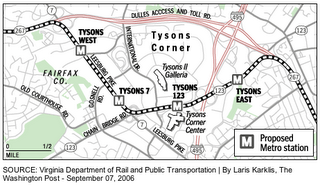
It's official. No tunnel for Metro through Tysons.

I should start off by saying that it's not all Fairfax County's fault. Many of their current leaders have learned from their past mistakes with Metro and development, and were ready to do the right thing this go round. And I hate to slam Gov. Kaine for this one, because I think it's not totally his fault, although I would have liked to see him stand up to Tom Davis and tell him there's no way they're going to pull the federal funding. I think the blame for this shouldn't fall totally on Kaine in this regard. Part of it should definitely go to Tom Davis who made it clear that he never was willing to do whatever was neccessary to do transit "right" in Tysons.

You're talking about a place that is one of the largest employment centers in the entire country. There's 1/3 as much office space in Tysons as there is in the entire District! I have a hard time believing that if Gov. Kaine stood up for the tunnel, that he wouldn't have won that game of chicken.

The ironic thing about this latest failed opportunity to do transit to Dulles and Tysons right, is that many of the Fairfax supervisors and planners had learned from the past legacy of awful transit planning in Fairfax and were pushing for the tunnel because they knew how much of a difference it would make.

In the past, comparing Fairfax to Arlington or parts of Montgomery county (Bethesda) is a case study in harnessing the power of transit to channel growth and successful economic development with well-planned transit. In the book I just read, The Great Society Subway, Zachary Schrag has a chapter that uses Fairfax as an illustration of Metro done poorly in the suburbs.

I think a lot of today's Fairfax leaders remember these lessons. It's evident in this quote from the Post story:

"This will prove to be the wrong decision for the wrong reasons," said Fairfax Supervisor T. Dana Kauffman (D-Lee), who is also on the Metro board. "Ten years from now, I regret my son may pick up a planning text where Fairfax's long-awaited rail extension is highlighted as a failed attempt at service and economic development. It can't only be about the here and now."
What's the point of doing something halfway, even if it is cheaper? These lines are expected to be there for 100 years or more, and there's no sense in thinking only about getting it done as cheaply as possible if it sacrifices potential to make a great place.

I'd like to see more comments like the one I read in The Great Society Subway from Cleatus Barnett, a Montgomery County representative: "We were building these lines for eternity. You're not going to pick them up and move them if you put them in the wrong place. They are there forever. And don't tell me anything about the cost. If it costs more, it costs more, but that's what we're going to do."

So, while perhaps a majority of Fairfax leaders saw the wisdom of finally doing transit "right", karma can be a b---h. They had no less than three opportunities to take the Vienna line to Tysons instead back in the 60's and 70's. Instead, they put it out to Vienna, placed it in the middle of the interstate, and allowed next to no dense transit-oriented development around the stations.

And meanwhile, Rosslyn and Ballston are great places, friendly to cars AND people, while the area around the Vienna stop, is a magnificent, uh.....parking lot.

It's a shame that Fairfax learned their lesson just a bit too late, especially because all of us will have to deal with the consequences for years and years.

Tysons is a miserable place now, but now they've ensured that their future will be filled with years of miserable traffic, un-walkable streets, lack of distinctive character, and the unmistakable geography of no-place.

Tysons' best opportunity to position themselves to survive when gas is no longer cheap and people are tired of living entirely in a car just passsed them by. And it will continue to pass them by each day on the expensive elevated tracks running right through the middle of Chain Bridge Road and Leesburg Pike.