Showing posts with label Placemaking. Show all posts

Tuesday, July 31, 2007

Well, if you've gotta cut the neighborhood in half...

...you might as well make good use of typically underutilized space. This is the area under the SE/SW freeway that cuts off the greater Navy Yard area (and greater SW) from the rest of 8th Street SE, Barracks Row, and Capitol Hill. I'm not sure how this came to be, but it's a great use of space that ordinarily just becomes parking or a haven for criminals and those who want to stay out of sight.

I was poking back through some old photos on Flickr, and I saw this photo from our self-guided alley tour we did of Capitol Hill awhile back.

Anyone local know how this got installed?


UnderpassBBall.JPG, originally uploaded by whiteknuckled.

Thursday, May 10, 2007

Ugh: Urban real estate marketing makes me sick

I'm doing a little research into the whole project, so I won't go into detail about it right now, but I just downloaded the National Gateway brochure from their website after reading this story in the Post over the weekend.

They certainly aren't the worst of the bunch, but half the time, whoever has to write the dreck that appears on the marketing materials of the developers of condos and massive projects in DC likely flunked out of greeting card-writing school. I mean, haven't we all seen some really awful ones out there?

Have you seen these:

• The "eat", "sleep", "play" designation on the floorplans for new condo buildings are beyond annoying. "Boy, I can't wait to have some people over once I buy that new condo," said the hip urban single male. "Hey everybody, let's head into 'play' now that we've had some good stuff from 'eat'. Later, maybe one of you ladies will be lucky enough to make it back to 'sleep'. I mean, provided you want to either read or sleep, though, because those are the only options."


• Words that make me want to egg your building: "Distinctive", "Upscale", "Sophisticated", "Breathtaking", "Up-tempo", "Spectacular", "Dramatic", "Stunning". And FYI, I'm pretty sure the Allegro uses half of these on a regular basis.

• Claiming to be "just minutes from" Adams Morgan, Dupont, Downtown, Georgetown, and Capitol Hill, all at once. If you haven't seen this one on Craigslist, then you haven't been looking for an apartment anytime in the last...well...forever. Why don't you just go ahead and say "convenient access to The Moon."

• Once in the city and not doing the park and ride thang from miles away, 2 miles away does not qualify as NEAR the Metro. Believe me, I know a thing or two about walking to Metro.

• Anything that claims to now be "the most desirable address in Washington DC" makes me want to vomit. Not that all of us want to be president or anything, but you're pretty much not going to top 1600 Pennsylvania.

• USING ALL CAPITAL LETTERS ON MAILINGS, CL ADS, OR REAL ESTATE DOCUMENTS. SERIOUSLY, PEOPLE, IS THIS THE FIRST TIME YOU'VE USED A COMPUTER?

Here are some direct quotes from condo websites I've seen lately:
• "With such an array of combinations, you can make the lifestyle you envision a reality." Provided you have an eternal supply of cash, of course.

• "Columbia Heights is turning into the golden child for DC developers." Uh...are you selling to people or developers?

• "A dynamic atmosphere with a unique personality, the neighborhood boasts a rare and unique blend of commercial, residential and cultural experiences for its residents." blah blah blah blah blah

• "The _____ appeals to those who seek balance — balance between modernity and warmth." ?????

• "Convenient NW location - easy access to the White House, Capitol, Central Business District, C&O Canal, Potomac River, & Reagan National & Dulles Airports." Dulles? Really?

Anyway, so what got me all started on this was some blurbs from the National Gateway brochure:
• "The project will integrate over 185,000 square feet of restaurants, services, and shops in an architecturally significant streetscape that will define a sense of place rarely found in an urban location."

• "At National Gateway we endeavor to create a unique business environment, one in which sweeping views of the Potomac River, Washington, D.C. and a lush Center Park become part of the everyday landscape. And one in which the alignment of location, environment, access and visibility combine to create a vibrant mixed-use community that is more than a work place.” – David Cheek, President, The Meridian Group

• And lastly, "Setting new standards in urban design, National Gateway at Potomac Yard, Arlington Offers tenants an innovative mixed-use experience."
Whoah, dude, I have TOTALLY been craving an "innovative mixed-use experience". I have SO been trying to put words to the feeling I've had ever since I fell in love with the city. Jane Jacobs could have saved herself so much work if she had just latched onto that compelling sentence to describe the Village in NYC. Take that Robert Moses! "Don't infringe on our innovative mixed-use experience!"

As far as "setting new standards in urban design", I wouldn't count on it. And why bother, anyway? The old standards are actually pretty good.

Sunday, April 22, 2007

The Awakening being dug up by "visionary developer" for sake of "controversy"


If you haven't heard it already this morning from DCist, the Express, or pissed-off coworkers at the coffeemaker, Milt Peterson has announced his plans to dig up The Awakening from Hains Point and take it to his new fancy-schmancy Disney-esque National Harbor in PG County just below the Wilson Bridge on the Potomac.

Read the Post story here.

I was in CVS in Chinatown grabbing a pack of gum this afternoon while on my way into church when I saw this story on the frontpage of the Post. I picked it up while standing in the forever-long line after the picture on front caught my eye.

It's not enough that he's going to dig the thing up from the District, where it's in the public realm (though techincally privately-owned) on National parkland, at the majestic tip of Hains Point. But he has to go and show his mug for the cameras down there in front of the sculpture while all the kids are playing on it. For the record, when I told the Bride about this, she nearly started crying. Way to go, Milt. Thanks for that one.

Everytime we go to Hains Point, usually on bike, we remark how it's one of the best-kept secrets in the District. Most of the tourists walking around downtown and the Mall can't get all the way down there, many of the ones driving don't know how much there is to East Potomac Park and don't venture down there, and even people who live here don't know where it is or how to get there (though they certainly should!)

I think this is a terrible idea, even keeping the discussion separate from whether or not National Harbor is going to turn out to be a worthwhile place to visit for those people in pursuit of authentic experience that places like National Harbor and chain-store malls typically DON'T offer. I don't have the greatest amount of faith in the place-making abilities of a man who has spent his life plopping down suburban strip malls and office parks wherever he can in Northern Virginia for the last 30 years.

I don't like The Awakening being removed for several reason: a) I think it should stay in the District. I have no great rationale for this other than the fact that I'm biased, I love the District, and I think it's a great asset and a good fit for Hains Point. That should be enough.

But my greater concern is how it's going to be used on the waterfront at National Harbor. Supposedly, it's going to be the centerpiece of a grand avenue that is the "main street" of the development, with stairs going down to the sandy beach where The Awakening will rise up out of the ground. (I won't discuss right now how the avenue is going to be lined with "stonehenge" replicas, which really only makes me think of Spinal Tap and little leprechauns)

What I have yet to have explained to me is how the relationship between public and private space will unfold at National Harbor. Are all the streets and sidewalks public space? Or is National Harbor going to be a glorified shopping mall or "lifestyle center", which is fancy-real-estate speak for "mall with lid off that is a poor imitation of a real main street."

I'll reserve my final judgement about just how awful I think this plan is until I can clarify this one issue. I think the Awakening should be in a place that is publicly accessible, so that everyone can enjoy it without having to go to a mall (or Maryland for that matter) to see it.

If access to the waterfront and the streets in National Harbor are going to be private and restricted by the owners/management, I'll just go ahead and say that this dude just robbed the District and snatched one of our best pieces of public art in the District and put it in an awful place.

"It's going to be POW! It's going to be explosive! We're going to change Washington."

Someone needs to tell the guy that National Harbor isn't IN Washington. And people don't arrive by boat up the Potomac. Yes, a lot of people cross the Wilson Bridge, but the idea that Washington, the land of beautiful monuments and an inspired street plan to draw attention to meaningful civic buildings, needs a glorified mall to "change" it is ludicrous.

But this quote says it all, to me:

Moving the sculpture away from the District could create a stir, Peterson realizes. That's exactly what he's looking for. You want it to be controversial, he says. Provocative. The worst thing would be no reaction at all.

Awesome. You took The Awakening away from the District to put it in your mall to be controversial. That's fantastic.

----


Read some of Richard's thoughts on National Harbor from a while back, and a column in the Post by Michele Dyson

Wednesday, March 28, 2007

Whaddya mean it wasn't made for people and books

When the new Seattle Library was opened several years ago, it was hailed as a groundbreaking, iconic example of breathtaking civic architecture (Not by everyone, certainly) Now, even one local architecture critic who initially praised the building has changed his tune — now that he's actually had to USE the building, he's discovered that it's less than friendly and inviting to people. Imagine that.

An article in the Seattle Times from opening day has a comment from a fellow architect inspecting the library for the first time:

Yesterday he traced his hand along the library's walls. He sketched drawings and jotted ideas in a black journal. He said he admires Koolhaas because he doesn't rely on precedent or formality."
Not relying on precedent or formality is very often what leads to buildings like this.

A critic from the P-I has reevaluated his view on how the library works after he realized "when I need to spend a working day at a library, I retreat to the Bellevue Regional instead of Seattle's downtown flagship."

He concludes:
There's something missing from the art in this building, and it's so basic and simple that it can be captured in one word: warmth. A great 21st-century library building should stretch our imaginations and aspirations beyond the book-centered technology of the past, and this one certainly does. But we depend on buildings to remind us from where we've come as well as where we might go. The Central Library breaks so radically with the character of the traditional public library that nothing remains as an anchor except the books themselves -- and they seem almost like afterthoughts, dust specks adrift in deep space. This library feels communal and theatrical instead of personal and contemplative, focused so outwardly on the world that it has no time for the individual.

Based on this other quote from one of Koolhaas' colleagues who worked on their library, they're quite confused. "Question from P-I reporter: What is the one thing that you hope that the public will notice about this library? That it is not willful. That its design is totally in service to making a great library ... and that its form is an answer to how it functions."

So they threw out the book on library design for the last 200 years, but somehow managed to insist that they came up with a design where form follows function? If you wanted to make a building where the design is truly in service to making a great functional library where PEOPLE will enjoy spending time, maybe they should have paid attention to convention, precedent and history.

There's a good lesson here for DC Council members who are even now in the throes of figuring out what to do with the Central Library. While the building may carry some significance due to its creation by black box-creator extrordinaire Mies Van der Rohe, it's an abysmally-designed space inside for books and people — which by the way — are what libraries are for.

Monday, March 12, 2007

What we lost...(or rather, what Metro Properties and the Allegro took):

Without writing an entire paper on the importance of the tree canopy—which has arguably, a greater importance in urban areas due to the decreased availabilty of space—I've discovered some good resources on the urban tree canopy here in DC.

Thanks to "Alaaro", another contributor to the CH discussion forum, I discovered the Casey Trees Endowment, which works on preserving and enhancing the tree canopy in the District. Here are just a few facts about the trees that were removed by Metro Properties, Inc., the developers of the Allegro:

There were 5 trees removed, which you can see on the graphic from the Casey Trees interactive tree map, which is one of the coolest things I've ever seen. I think they used their endowment to do a huge survey of all the trees in the District, which is just an amazing resource.


14th Street is running right through the middle of the graphic. (The yellow dot at the top on the west side of 14th Street is still standing, I believe) So, starting at the bottom left green dot and continuing north, here is some information on the trees that were removed.

Tree 1: Scarlet Oak

  • Height = 40 feet
  • Diameter at Breast Height = 14 inches
  • Crown Radius = 15 feet
  • Value = $3,597
  • Tree was rated 1-2 in health, with 1 being the highest
Tree 2: Scarlet Oak (in a treebox near the street edge)
  • Height = 50 feet
  • Diameter = 27 inches
  • Crown Radius = 20 feet
  • Value = $8,387
  • Tree was rated 3-4 in health (this was likely one that was due to be removed)
Tree 3: Scarlet Oak (set back near lot line - probably difficult to build around)
  • Height = 30 feet
  • Diameter = 17 inches
  • Crown Radius = 15 feet
  • Value = $4,499
  • Tree rated 1-2 in health
Tree 4: Scarlet Oak (in treebox near street edge)
  • Height = 35 feet
  • Diameter = 18 inches
  • Crown Radius = 15 feet
  • Value = $5,023
  • Tree rated 1-2 in health
Tree 5: Scarlet Oak (judging by health score, probably the other tree due to be removed)
  • Height = 50 feet!
  • Diameter = 28 inches!
  • Crown Radius = 20 feet
  • Value = $9,010
  • Tree rated 3-4 in health
One of the niftiest thing about the Casey Trees site is that they've calculated and quanitified many of the environmental benefits of these trees. According to their calculations, here are a few interesting stats about the combined benefits of these 5 trees. (Values rounded):
  • 4680 kg of carbon currently stored to date.
  • 130 kg per year of carbon that would have been taken out of the air and stored over the next year due to growth
  • 154 grams of Carbon Monoxide pollution removed each year
  • 1356 grams of Ozone pollution removed each year
  • $ 30,516 - total value
Compare that to a comparable newly planted Willow Oak over by the Giant. It's 2 inches in diameter and 15 feet tall, so it's a little smaller but pretty close to the ones that the Allegro proposes for replacement. After 2-4 years in the ground, we could probably expect numbers like these: 2 kg of carbon stored, .5 kg of carbon stored per year, 2.5 grams of CO removed each year, and 21 grams of ozone removed, with a value of roughly $70-$100. Multiply that by 6 and compare the numbers to the above figures:
  • 12 kg of carbon currently stored to date.
  • 3 kg per year of carbon that would have been taken out of the air and stored over the next year due to growth
  • 15 grams of Carbon Monoxide pollution removed each year
  • 126 grams of Ozone pollution removed each year
  • $ 420 - $600 total value
DC has some great resources from the UFA, which you can view online at the UFA/DDOT site. I found this one to be of particular interest, called "Trees and the Construction Process...Basic Concerns and How to Avoid Problems" It appears to be a presentation that former UFA employee Ainsley Caldwell made to government workers and other construction and maintenance related departments.

WHY ARE TREES IMPORTANT?
  • Trees represent a significant investment for the District in time and money
  • DDOT spends more than seven million dollarsfor annual upkeep and tree planting
  • Actual dollar value of the District’s street tree resource is estimated between 50-80 million dollars
  • Trees can add 7–20 percent to the value of a home

Here's what 3460 14th Street NW once looked like, thanks to Google Earth:

Does the Allegro REALLY care about Columbia Heights?

(January 2006 image from columbiaheightsnews.org)
UPDATED with new information:
When walking my wife (and her brother who was in town for a visit) home from the Metro Thursday night, we walked by the site of the old Giant on our way home, like we always do. We've been watching the progress as the old Giant has come down and site prep has been done to clear the way for a new condo building. But what we saw last week certainly represented anything but "progress".

(all other photos © by me)
I was dismayed to see empty treeboxes, scattered limbs, and giant stumps sitting on the sidewalk, where there used to be 5 giant Scarlet Oak trees, all of which were more than 35 feet tall. I couldn't believe my eyes. Two of the trees were closer to the lot line, which is where the front of the Allegro will actually begin, where there was just a parking lot for the old Giant. But two of the trees were at the very extreme edge of the sidewalk in treeboxes, in line with the parking meters (still there) and city signage. I know that the developers of the Allegro will likely have to do massive infrastructure work along the front of their property to expand utilities, sewer and water pipe, and electrical conduit. So I could POSSIBLY understand the need to remove the two trees up close to the building.


But I can't imagine for the life of me why they had to remove the trees at the edge of the sidewalk. I also thought that there HAD to be laws on the books protecting the tree canopy in town and ensuring that construction doesn't eradicate them—or at least ensure that adequate replacements are planted.

Thanks to a tip from "nkatekwan", one of the many frequenters of the Columbia Heights discussion forum, I put a call into the Urban Foresty Adminstration of the District, which is part of DDOT. With a quick request for information I found out that the "request for tree removal" permit that was applied for by "Metro Allegro" for 3460 14th Street NW was DENIED.

Well, that was the initial answer from a woman in the UFA office, which was accurate according to the paperwork she had in front of her. So after ripping Metro and Allegro for 20 minutes of my lunch break, I got a call back from Ranjit Singh, who works for UFA at DDOT, so here's the current info:

Two of the trees were scheduled for possible removal by the UFA due to poor health and danger of falling. I'm guessing this would be the two trees marked in yellow on the Casey Trees survey, only one of which was close to the lot line. So their request to remove at least those two trees would have been fine, but they had to sell the UFA on why the other 3 should be removed.

Ranjit Singh told me that their office met with Metro Properties and the Allegro folks several times and they sold them on the removal of the other trees based on a few things that they pledged to do.
  1. Metro demonstrated that they would have to completely remove the sidewalk to facilitate the upgrades to the site.
  2. They proposed plans for 6 replacement trees, (3-inch saplings, according to Singh)
  3. and improvements to the soil by installing something called "structural soil" which increases soil density,
  4. And some sort of underground barriers that will give the roots room to spread out
  5. All of which will make future tree growth more stable and successful.
When I inquired about the size of the 6 replacement trees and what we could expect there, he almost laughed when I asked if these trees were going to be large in size or in any way comparable to the Oak trees.

I also asked him if it wasn't preferrable to do absolutely whatever was necessary to preserve the trees in good shape at the sidewalk edge, acknowledging that no improvements to the soil or new saplings can replace old-growth hardwoods. He said that it was, but just didn't seem feasible on this site. For what its worth, he seemed bummed out that the trees had to go. I suspect the UFA is a fairly unpopular place among developers — and they have a tough job trying to preserve the things that get in the way of a lot of development and "progress". I'll expand on it some other time, but from what I could learn from the UFA website at dc.gov, they do a lot to promote the benefits of a healthy tree canopy—from a health, aesthetic AND economic competitiveness perspective, which is certainly the way to talk to developers.

The sad truth is absolutely nothing can be done to replicate what was there anytime soon and get these beautiful trees back in the ground—shading the sidewalk, removing CO2, and producing oxygen once more.

So at the end of the day Metro Properties and the Allegro may have gotten their permit, and they may be investing money in new (very tiny) trees and improved soil and root space, but they have permanently scarred their section of the street in a neighborhood that they tout and claim to "love". Somehow I doubt their devotion to the neighborhood, except to the few who have purchased a condo.

And for the record, these are the same people who initially refused to put in any space for retail on the ground floor, irregardless of the massive neighborhood support for it. Metro Properties' Jeremy Rubenstein even went so far as to post a letter stating why it was a bad idea to have retail in the ground floor. Which was funny about 6 months later when they changed their stance completely and claimed it had nothing to do with citizen feedback and everything to do with "the market" which had apparently turned overnight.

I tried to contact the Metro people through the Allegro website, leaving them a message about how dismayed I was, trying to find out why, and then telling them that when we do finally decide to buy a place in this neighborhood, we'll be sure to steer clear of the Allegro.

I got a form email back telling me "Thank you for your interest in Allegro." Gee, thanks for that. Consider this to be my middle finger raised high as I say, "we salute you, Allegro and Metro Properties".

----

I'll post more information as I get it. Let me know through the comments if you hear anything else about it. Also, if any of you have pictures of what this sidewalk used to look like, I'd love to see 'em or link to them. I've got some somewhere, but it'll take some digging to find them. And if someone from Metro Properties stumbles across this, feel free to clear up the situation for us if all is not as it appears. I'd love to hear it. And I'd certainly love to hear the amazing benefits of 3-inch saplings (according to Singh) compared with 18-inch Scarlet Oaks.

Here are the rest of the pictures from this morning. (Try to hold back the tears, coworkers might look at you funny.) I'd say this first one about sums it all up, don't ya think?


Thursday, September 07, 2006

Fairfax misses a chance. Again.

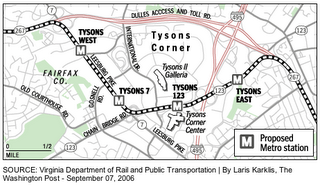
It's official. No tunnel for Metro through Tysons.

I should start off by saying that it's not all Fairfax County's fault. Many of their current leaders have learned from their past mistakes with Metro and development, and were ready to do the right thing this go round. And I hate to slam Gov. Kaine for this one, because I think it's not totally his fault, although I would have liked to see him stand up to Tom Davis and tell him there's no way they're going to pull the federal funding. I think the blame for this shouldn't fall totally on Kaine in this regard. Part of it should definitely go to Tom Davis who made it clear that he never was willing to do whatever was neccessary to do transit "right" in Tysons.

You're talking about a place that is one of the largest employment centers in the entire country. There's 1/3 as much office space in Tysons as there is in the entire District! I have a hard time believing that if Gov. Kaine stood up for the tunnel, that he wouldn't have won that game of chicken.

The ironic thing about this latest failed opportunity to do transit to Dulles and Tysons right, is that many of the Fairfax supervisors and planners had learned from the past legacy of awful transit planning in Fairfax and were pushing for the tunnel because they knew how much of a difference it would make.

In the past, comparing Fairfax to Arlington or parts of Montgomery county (Bethesda) is a case study in harnessing the power of transit to channel growth and successful economic development with well-planned transit. In the book I just read, The Great Society Subway, Zachary Schrag has a chapter that uses Fairfax as an illustration of Metro done poorly in the suburbs.

I think a lot of today's Fairfax leaders remember these lessons. It's evident in this quote from the Post story:

"This will prove to be the wrong decision for the wrong reasons," said Fairfax Supervisor T. Dana Kauffman (D-Lee), who is also on the Metro board. "Ten years from now, I regret my son may pick up a planning text where Fairfax's long-awaited rail extension is highlighted as a failed attempt at service and economic development. It can't only be about the here and now."
What's the point of doing something halfway, even if it is cheaper? These lines are expected to be there for 100 years or more, and there's no sense in thinking only about getting it done as cheaply as possible if it sacrifices potential to make a great place.

I'd like to see more comments like the one I read in The Great Society Subway from Cleatus Barnett, a Montgomery County representative: "We were building these lines for eternity. You're not going to pick them up and move them if you put them in the wrong place. They are there forever. And don't tell me anything about the cost. If it costs more, it costs more, but that's what we're going to do."

So, while perhaps a majority of Fairfax leaders saw the wisdom of finally doing transit "right", karma can be a b---h. They had no less than three opportunities to take the Vienna line to Tysons instead back in the 60's and 70's. Instead, they put it out to Vienna, placed it in the middle of the interstate, and allowed next to no dense transit-oriented development around the stations.

And meanwhile, Rosslyn and Ballston are great places, friendly to cars AND people, while the area around the Vienna stop, is a magnificent, uh.....parking lot.

It's a shame that Fairfax learned their lesson just a bit too late, especially because all of us will have to deal with the consequences for years and years.

Tysons is a miserable place now, but now they've ensured that their future will be filled with years of miserable traffic, un-walkable streets, lack of distinctive character, and the unmistakable geography of no-place.

Tysons' best opportunity to position themselves to survive when gas is no longer cheap and people are tired of living entirely in a car just passsed them by. And it will continue to pass them by each day on the expensive elevated tracks running right through the middle of Chain Bridge Road and Leesburg Pike.